
BLOG Details

Fleet Telematics vs. Fuel Management System: Which Does Your Business Need First?

taabi-team
Fleet Telematics vs. Fuel Management System

Introduction

This is a question that lands on most fleet managers’ desks within six months of beginning their technology journey: we have a limited budget and two vendors making compelling pitches: one for vehicle telematics, one for a fuel management system. Which one comes first? The answer matters more than most operators realise, because choosing the wrong starting point means delayed ROI and frustrated adoption.

Defining the Terms Clearly

Fleet Telematics

Fleet telematics is the broad technology discipline of collecting, transmitting, and analysing data about vehicle location, speed, movement, and driver behaviour using GPS devices and onboard diagnostic (OBD) connections. A telematics system tells you where your vehicles are, how fast they are going, whether drivers are braking harshly, and how many hours each vehicle has been in operation. It is primarily a visibility and compliance tool essential for fleet tracking, route adherence, and regulatory reporting.

Fuel Management System

A fuel management system for a fleet goes a layer deeper. While telematics tracks vehicle behaviour, an FMS specifically monitors, controls, and optimises fuel consumption. It adds fuel-level sensors to the data mix, correlates GPS and fuel data to detect pilferage, analyses consumption against load and route variables, and generates actionable intelligence to reduce fuel spend. It is primarily a cost-reduction and efficiency tool.

Where They Overlap, and Where They Don't

Capability Telematics | FMS | Both
GPS vehicle tracking
Yes | Partial | –
Driver behaviour monitoring
Yes | Partial | –
Real-time fuel level monitoring
No | Yes | –
Pilferage detection
No | Yes | –
Refuelling station optimisation
No | Yes | –
Route optimisation
Yes | Partial | –
Predictive maintenance alerts
Partial | Partial | Best together
Compliance & regulatory reporting
Yes | Partial | –
Fuel cost reduction ROI
Indirect | Direct | –

The ROI Case for Prioritising the Fuel Management System
Fleet Telematics vs. Fuel Management System
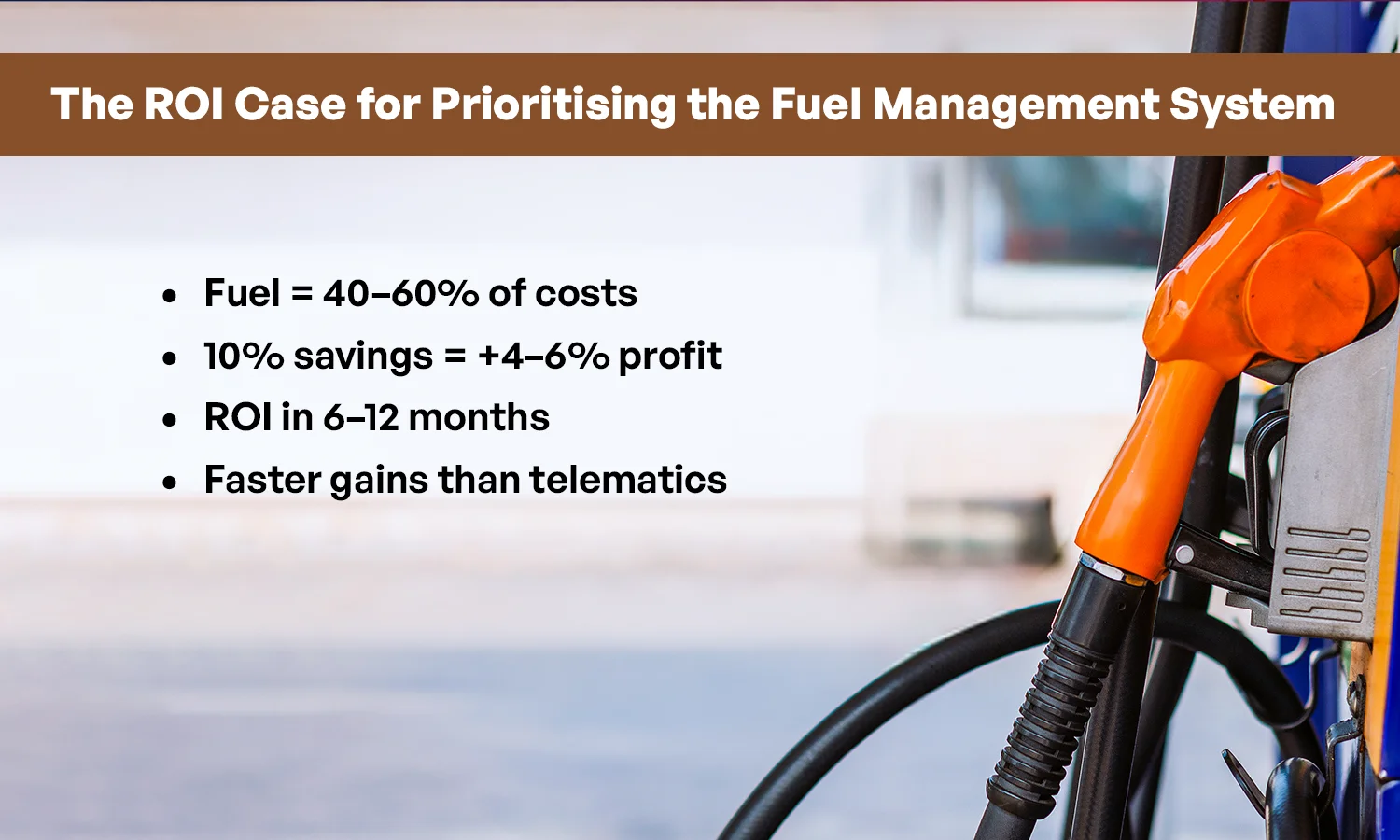
For most Indian fleet operators, particularly those managing 20 or more vehicles on long-haul or multi-state corridors, the fuel management system delivers faster, more measurable ROI than a standalone telematics deployment. The reason is arithmetic: fuel is the single largest variable cost in the P&L, often representing 40–60% of operational expenses. A 10% reduction in fuel spend directly adds 4–6% to the operating margin. Telematics savings, while real, are more diffuse, spread across driver behaviour improvements, route efficiency, and maintenance cost reductions that materialise over a longer timeframe.
Industry benchmarks confirm this. Fleets implementing an FMS first typically achieve full ROI within 6–12 months. Fleets that start with telematics alone average 18–24 months to the same ROI point. For a cash-constrained logistics business managing tight freight margins, that timing difference is significant.

The Case for Telematics First

There are scenarios where telematics should come first. If your primary pain points are driver safety incidents, route compliance violations, or regulatory reporting burdens, then a telematics platform that addresses these risks first is the more targeted investment. Similarly, if your fleet operates primarily on urban last-mile routes with short distances and controlled refuelling at company depots, fuel pilferage risk is lower, and the telematics-first case becomes stronger.

The Best Answer: A Platform That Does Both

The most sophisticated fleet operators are moving beyond the either/or debate. Modern fleet intelligence platforms integrate telematics and fuel management into a single unified view, so that GPS data, driver behaviour analytics, fuel consumption figures, and predictive maintenance insights all flow into the same dashboard. This integration is where the real value emerges: correlating a driver’s harsh braking events with their fuel consumption per kilometre, or linking a vehicle’s declining engine health to its degrading fuel efficiency.
Taabi’s platform is built on exactly this integration philosophy. Rather than selling telematics and FMS as separate products, Taabi’s AI engine synthesises data from IoT fuel sensors, OBD devices, GPS trackers, and video telematics into a single operational intelligence layer. Fleet managers see the complete picture, allowing decisions that improve safety, efficiency, and profitability simultaneously.

Practical Guidance: Making the Decision

To decide where to start, ask three questions: Where does your biggest monthly cost variance come from, fuel or operational incidents? How robust is your current fuel tracking? Can you calculate fuel efficiency per driver per route today? Do you have active regulatory compliance gaps that pose immediate business risk? If fuel variance is your dominant pain point and your tracking is currently manual or paper-based, start with the fuel management system. If compliance gaps are acute, start with telematics. If the budget allows, implement both simultaneously on a pilot cohort; the integration benefits materialise immediately.
TAABI APPROACH

Taabi’s device-agnostic SaaS architecture means you can start with fuel management, telematics, or both, and add modules as your operational maturity grows. All data flows into one unified intelligence platform from day one.
Explore Taabi’s Fuel Management System and Taabi’s Fleet Management System to see the integrated platform in action.

Not Sure Where to Start?

Taabi’s team will map the right solution to your fleet’s biggest cost driver.

FAQs

Is a Fuel Management System more effective than basic Telematics?
Yes. While telematics offers visibility, an FMS provides direct cost command by detecting siphoning and waste that location tracking alone cannot see.
Can I integrate fuel sensors into my existing GPS tracking system?
Yes. Most 2026 platforms are hardware-agnostic, allowing you to bridge high-precision fuel sensors with your current GPS for a unified intelligence layer.
What is the typical ROI timeline for an FMS in India?
Indian fleets typically achieve full ROI within 6 to 12 months, driven by an immediate 10% average reduction in fuel waste.
How does AI distinguish between fuel theft and normal consumption?
AI identifies “vertical drops” in tank levels during engine-off hours, distinguishing theft signatures from the gradual slopes of regular engine consumption.
Does a Fuel Management System help with driver retention?
Yes. It provides objective data to reward top performers, removing unfair suspicion and creating a transparent, incentive-based culture for honest drivers.

Read More Blogs

Expand your horizons with a wealth of captivating articles that complement our featured blogs; offering further perspectives, valuable insights, and a deeper exploration of the topics that intrigue you.

Subscribe now

Looking for Deep-Tech Logistics & Fleet Management Solutions?

Access the latest trends, expert commentary, and indicators for unique insights into the global economy.