Commercial Vehicle Health Monitoring to Prevent Breakdowns

Key Takeaways
➤Commercial vehicle health monitoring tracks engine and system health in real time.
➤Early alerts prevent roadside failures and costly repairs.
➤Health monitoring improves driver safety by reducing breakdown risk.
➤Fleets save money through better uptime, fuel performance, and planned servicing.
➤Taabi offers truck-first health monitoring backed by integrated tracking.
Introduction
A truck breakdown never happens at a “good time.” It hits in the middle of a trip, delays delivery, puts the driver at risk, and adds an unexpected repair bill. For commercial fleets, one small mechanical issue can snowball into days of loss.
That is why commercial vehicle health monitoring is becoming a must-have for fleet owners. It helps you spot early warning signs in engine and vehicle systems, so you fix problems before they turn into roadside failures. When paired with tracking and telematics, fleets get full control of vehicle performance, trip reliability, and driver safety.
This blog explains what commercial vehicle health monitoring is, how it works, and how it prevents breakdowns before they happen.
What Is Commercial Vehicle Health Monitoring and How Does It Work?
Commercial vehicle health monitoring is a system that tracks the condition of fleet vehicles using onboard diagnostics, sensors, and telematics data. It collects information from the engine and other critical parts, then shows it on a dashboard for fleet managers.
Here is how it usually works:
- ➤Sensors and diagnostic links read parameters like engine temperature, battery health, fuel system status, and fault codes.
- ➤The data is sent through a telematics unit to a cloud platform.
- ➤Fleet managers get alerts when a value crosses safe limits or when a fault code appears.
- ➤The system also builds a maintenance history, making it easier to plan service on time.
In simple terms, it is like doing a constant vehicle health check while the truck is running, not after it fails.
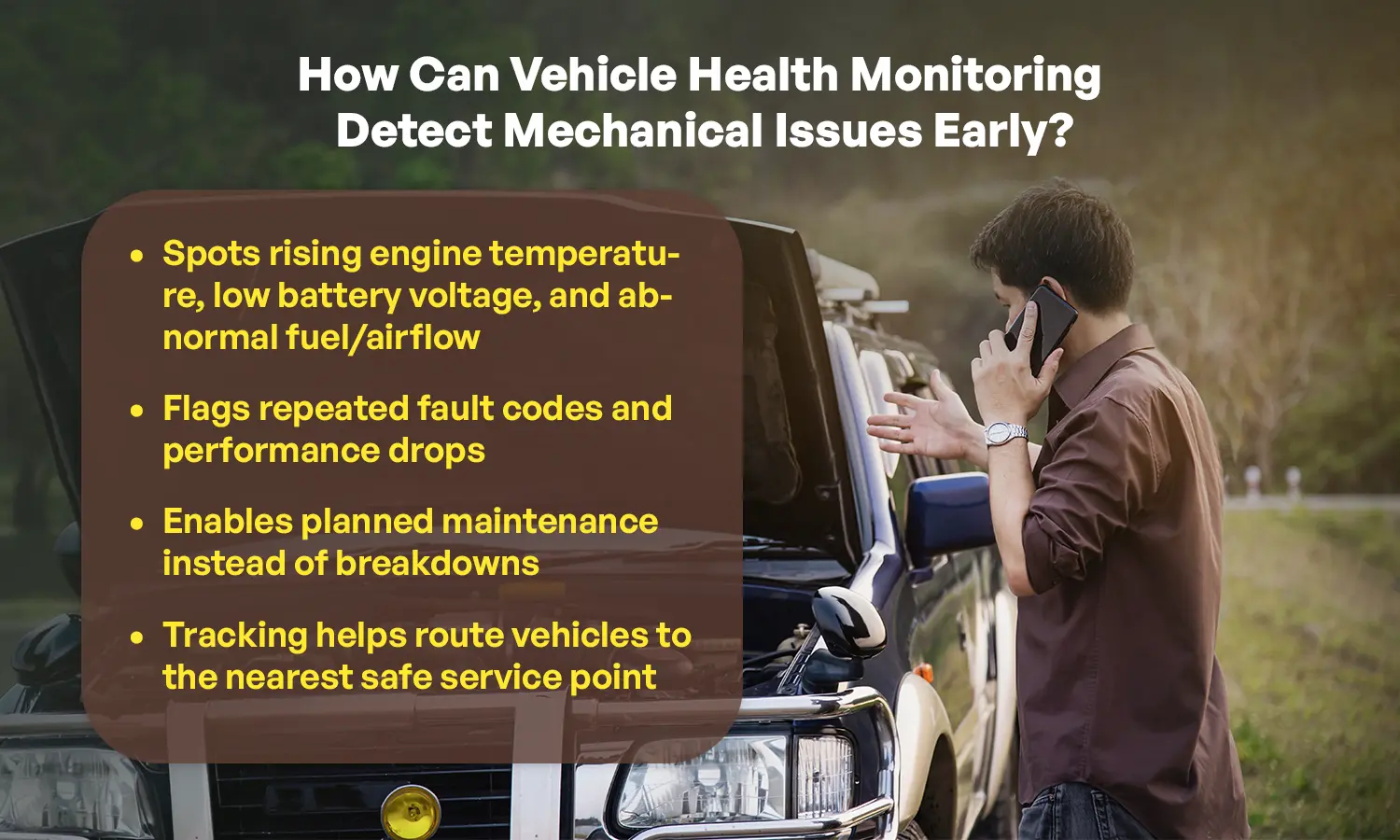
How Can Vehicle Health Monitoring Detect Mechanical Issues Early?
Most breakdowns give signals before they happen. The problem is that drivers and managers do not always see them in time.
A strong commercial vehicle health monitoring system catches warning signs such as:
- ➤Rising engine temperature over multiple trips.
- ➤Battery voltage drops.
- ➤Unusual fuel pressure or airflow readings.
- ➤Repeated fault codes pointing to the same part.
- ➤Engine performance changes after heavy loads.
Because these signals are tracked daily, fleets can service the vehicle in planned downtime instead of waiting for a breakdown. This reduces repair costs and keeps trucks running longer.
When health monitoring is connected to a vehicle tracking system, managers also know where the vehicle is, so they can guide it to the nearest safe service point if a risk grows during a trip.
How Does Health Monitoring Reduce Safety Risks for Fleet Drivers?
Breakdowns are not only a cost issue. They are a safety issue.
A truck that fails on a highway puts the driver in a risky position, especially at night or in high-speed zones. Mechanical issues like brake wear, tyre failures, or engine overheating can also cause accidents if ignored.
With commercial vehicle health monitoring, fleets reduce these risks by enforcing timely servicing and stopping unsafe vehicles from running long routes. Alerts help managers intervene early, and drivers feel more supported because they are not left alone on the road with a failing truck.
When combined with GPS fleet tracking, fleets can quickly locate a stopped truck and send help faster. The result is better safety for both drivers and cargo.
In What Ways Can Vehicle Health Monitoring Lower Operational Costs?
The biggest savings come from preventing failure, not fixing it.
A fleet that uses commercial vehicle health monitoring reduces costs in four key ways:
➤Less downtime
Trucks stay on the road more days per month, so fleet output improves.
➤Lower repair bills
Fixing a small part on time costs far less than replacing a failed system later.
➤Better fuel performance
Healthy engines burn fuel efficiently. Poorly maintained ones waste fuel without warning.
➤Smarter maintenance planning
Dashboards help managers schedule service by need, not guesswork.
Many fleets also pair health monitoring with an automotive gps tracking system or a GPS tracking system for vehicles to ensure repair planning matches real trip patterns. If one truck runs tougher routes, the system flags it for more frequent checks.
A connected real-time vehicle tracking system also prevents loss during breakdowns by showing exact stop points and helping dispatch the right support quickly. Even basic online vehicle tracking system tools add value here, but health monitoring takes it to another level by preventing the stop in the first place.
How Taabi Supports Commercial Vehicle Health Monitoring for Fleets
Taabi’s Vehicle Health Solution is built for commercial trucks and fleet operations. It tracks key engine parameters, fault codes, and performance trends, then shows them in a simple dashboard for managers.
With Taabi, fleets can spot early mechanical issues, plan preventive servicing, and reduce roadside failures. Taabi also integrates tracking into one view, supporting a commercial vehicle gps tracking system alongside health insights. This helps managers link vehicle condition with route load, driver habits, and trip stress.
For fleet owners, the value is clear: fewer unexpected failures, safer drivers, and more reliable deliveries.
Conclusion
Breakdowns are expensive, stressful, and avoidable in most cases. Commercial vehicle health monitoring helps fleets catch mechanical issues early, support drivers better, and keep trucks running with fewer surprises. When combined with GPS tracking and telematics, it turns maintenance into a planned routine instead of an emergency. With platforms like Taabi designed for truck fleets, commercial vehicle health monitoring becomes a practical way to protect uptime, safety, and long-term fleet costs.
FAQs
What Is Commercial Telematics?+−
Commercial telematics is a system that collects data from fleet vehicles like trucks and buses. It includes GPS location, driver behaviour, fuel data, and sometimes vehicle health signals. Managers use it to improve safety, planning, and cost control.
What Is GSM In Tracking?+−
GSM is the mobile network used to send tracking data from the vehicle to the fleet dashboard. GPS captures location, and GSM helps upload that location in real time so managers can see trips live.
What Blocks a GPS Tracker?+−
GPS signals can be blocked by tunnels, underground parking, heavy metal structures, or deliberate jamming devices. Most fleet systems store data during low-signal zones and upload it once connectivity returns, keeping trip history accurate.