

BLOG Details

Fuel Pilferage in India: How Much Are You Losing and How to Stop It

taabi-team
Fuel Pilferage in India

Introduction

Every fleet owner in India knows it happens. Most cannot quantify it. Fuel pilferage, the silent, systematic theft of diesel from commercial vehicles, is one of the most pervasive and least-measured profit destroyers in the country’s logistics sector. The problem is not new. But the scale at which it is now being quantified by AI-powered fuel management systems is opening eyes across the industry.

The True Scale of Fuel Pilferage in Indian Fleets

Industry estimates consistently place pilferage losses at 5–15% of total fuel spend in fleets without monitoring systems. For a 100-truck fleet spending ₹1.5 crore monthly on diesel, that translates to ₹7.5–22.5 lakh disappearing every month through deliberate diversion. Across India’s estimated 5 million commercial trucks, the aggregate annual loss runs into tens of thousands of crores.
The challenge is amplified by India’s logistics geography: long highway stretches, remote night stops, a fragmented network of fuel stations, and a cash-heavy transaction culture that makes receipts easy to manipulate. In this environment, pilferage has evolved from opportunistic individual acts into a sometimes-organised ecosystem involving drivers, pump attendants, and unauthorised fuel buyers.
Location in UP Approx. Diesel Price (Apr 2026)
Lucknow
₹92.10/litre
Kanpur
₹92.15/litre
Agra
₹92.05/litre
Varanasi
₹92.40/litre
Noida / Greater Noida
₹89.82/litre (Delhi rates apply)
Gorakhpur
₹92.60/litre

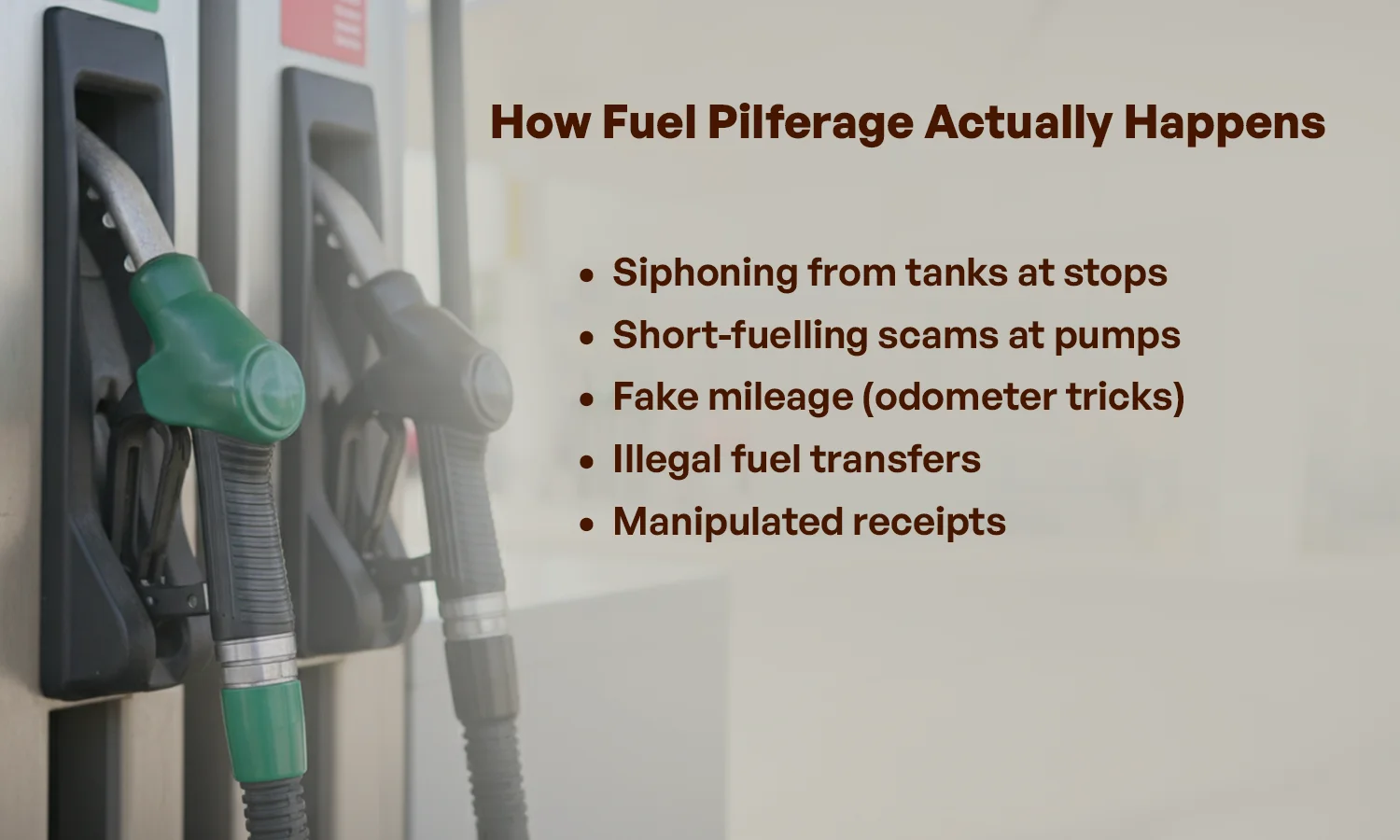
How Fuel Pilferage Actually Happens

Fuel Pilferage in India
Understanding the mechanics of pilferage is the first step toward preventing it. The most common methods in India include:
  • Siphoning: Physical removal of diesel from the tank, typically at overnight halts on remote highway segments. Most common on routes between Kanpur and Allahabad, and along Gujarat and Rajasthan freight corridors.
  • Short-fuelling: The driver and pump attendant collude to record a higher volume than actually dispensed, with the difference paid in cash to both parties.
  • Odometer manipulation: Drivers report inflated mileage to justify higher fuel consumption, masking actual fuel sold on the side.
  • Unauthorised tank-to-tank transfers: Fuel transferred between vehicles at remote stops, with only one vehicle’s consumption appearing in records.
  • Receipt manipulation: Paper receipts altered to show higher quantities, particularly common in fleets still relying on manual fuel logging.

Why Traditional Controls Don't Work

Most fleet operators attempt to control pilferage through a combination of paper receipt checks, monthly fuel efficiency reports, and driver warnings. These methods fail for a structural reason: they are all retrospective. By the time an anomaly is visible in a monthly report, weeks of loss have already occurred, the driver responsible may have moved on, and the evidence is gone. Pilferage is a real-time problem that demands a real-time response.

How AI-Powered Fuel Theft Detection Works

Modern fuel management systems attack pilferage at the physics layer. Here is how a platform like Taabi’s Fuel Management System detects and prevents theft:
  • Continuous tank-level monitoring: IoT fuel sensors provide real-time tank readings every few minutes. A sudden drop in fuel level that is inconsistent with the vehicle’s speed and location is flagged instantly, before the truck even reaches its next stop.
  • GPS-correlated fuelling verification: Every refuelling event is cross-referenced against the vehicle’s GPS location. If the purchase shows a station in Kanpur but the truck was in Lucknow at the time, an alert fires immediately.
  • Volume capacity cross-checking: The system knows each vehicle’s tank capacity. A fuel card transaction showing 200 litres dispensed into a truck with a 160-litre tank is flagged as a physical impossibility and a fraud signal.
  • Night-stop geofencing: High-risk locations, known pilferage hotspots, trigger heightened monitoring alerts when vehicles stop in these zones between 10 PM and 5 AM.
  • Behavioural pattern recognition: AI models learn each driver’s historical fuel consumption patterns. Deviations from established baselines are surfaced for review before they compound.

CASE DATA

A major Indian transporter running 2,000 trucks implemented Taabi’s fuel management system, starting with a 40-vehicle pilot. Within 60 days, pilferage-related anomalies dropped by 68% as drivers became aware of real-time monitoring. The deterrent effect alone accounted for 40% of the total fuel savings achieved. (Source: Taabi.ai / Mobility Outlook, 2025)

The Deterrent Effect: Prevention Over Prosecution

Fleet operators who have implemented fuel theft detection systems consistently report that the biggest impact is preventing theft from occurring at all. Drivers who know that tank levels are monitored in real time, that every refuelling event is GPS-verified, and that anomalies generate immediate alerts for their fleet managers, simply stop pilfering. The system changes the risk calculus without requiring confrontational enforcement.
This matters enormously in the context of India’s severe driver shortage, where 60 drivers are available for every 100 vacancies. Fleet owners cannot afford the dual cost of pilferage losses and driver turnover. A transparent monitoring system, communicated clearly to drivers as a mutual accountability tool rather than a punitive surveillance mechanism, preserves both profitability and driver relationships.

Implementation: What to Look For in a Fuel Theft Detection System

When evaluating fuel monitoring systems for pilferage prevention, prioritise: real-time alerts (not daily batch reports), hardware-agnostic IoT sensor compatibility, GPS-to-fuelling-event correlation, anomaly sensitivity calibrated to your vehicle mix and route profiles, and mobile access for drivers to view their own efficiency data. Taabi’s platform covers all of these, with 99%+ fuel algorithm accuracy validated across Indian fleet conditions.

Stop Losing Fuel to Pilferage

Taabi’s AI detects theft in real time , before it compounds.

FAQs

What is the average impact of fuel pilferage in India on fleet profits?
Estimates show unmonitored fleets lose 5–15% of their total fuel spend to theft; for a 100-truck fleet, this can mean losing up to ₹22.5 lakh every month.
Where are the highest-risk areas for fuel pilferage in India?
The Kanpur–Allahabad stretch on NH-19 and remote highway segments in Gujarat and Rajasthan are historically high-risk zones for siphoning during overnight stops.
How does AI detect fuel theft differently than manual checks?
Manual checks are retrospective and easy to manipulate, while AI uses IoT sensors to flag sudden “vertical drops” in fuel levels in real-time.
What is a short-fueling scam, and can it be stopped?
It involves collusion between drivers and pump attendants to record inflated volumes; AI stops this by cross-referencing GPS locations with the actual liters entering the tank.
Can drivers bypass digital fuel monitoring systems?
Modern systems like Taabi’s use hardware-agnostic IoT sensors and behavioral AI that identify anomalies even if a driver tries to manipulate the odometer or receipts.

Read More Blogs

Expand your horizons with a wealth of captivating articles that complement our featured blogs; offering further perspectives, valuable insights, and a deeper exploration of the topics that intrigue you.

Subscribe now

Looking for Deep-Tech Logistics & Fleet Management Solutions?

Access the latest trends, expert commentary, and indicators for unique insights into the global economy.