




Introduction
Beyond its massive population, Uttar Pradesh is the arterial backbone of the country’s freight network. The Delhi–Agra–Lucknow–Varanasi corridor and the parallel NH-19 route connecting Delhi to Kolkata together account for some of the highest freight volumes in India. For every fleet operator running trucks through UP, the diesel price in Uttar Pradesh is not a news item. It is a daily operational variable that directly shapes profitability on every trip.
What Is the Diesel Price in UP Today?
As of April 1, 2026, the diesel price in UP is approximately ₹92.00–₹93.50 per litre, varying slightly by district based on dealer margins and proximity to depots. This price has held stable for 12 consecutive months following the last government revision in April 2025, the longest uninterrupted price freeze in India since daily dynamic pricing was introduced in 2017. State VAT in Uttar Pradesh is one of the higher structures nationally, which is why the diesel price in UP sits above the national average for most urban markets.
| Location in UP | Approx. Diesel Price (Apr 2026) |
|---|---|
|
Lucknow
|
₹92.10/litre
|
|
Kanpur
|
₹92.15/litre
|
|
Agra
|
₹92.05/litre
|
|
Varanasi
|
₹92.40/litre
|
|
Noida / Greater Noida
|
₹89.82/litre (Delhi rates apply)
|
|
Gorakhpur
|
₹92.60/litre
|
Why UP's Diesel Pricing Hits Fleet Operators Harder Than Most
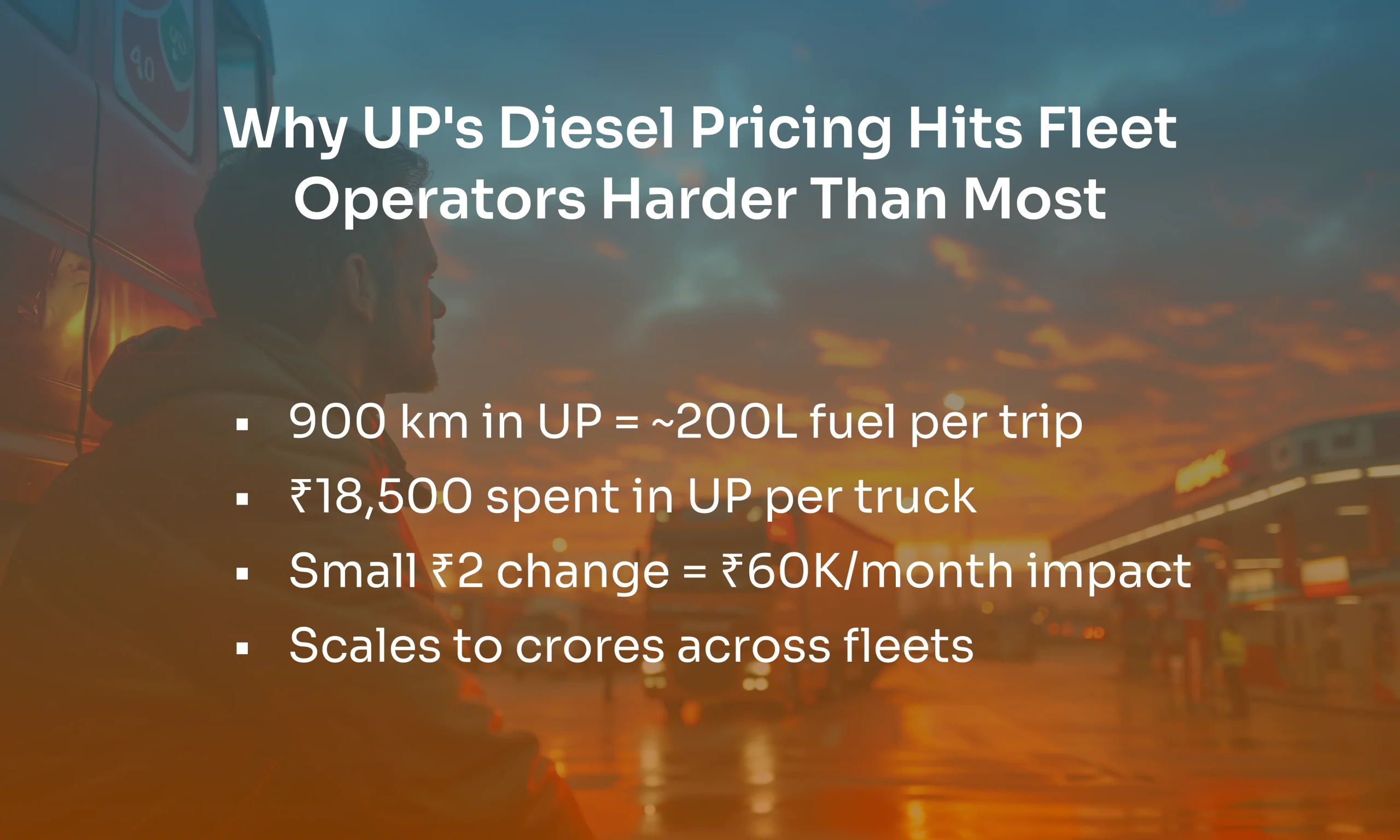
A truck running the 1,500-kilometre Delhi–Kolkata corridor passes through Uttar Pradesh for approximately 900 kilometres. At an average fuel efficiency of 4.5 km/litre for a loaded 40-tonne truck, that UP leg alone consumes roughly 200 litres. At ₹92.50/litre, the UP-segment fuel cost is ₹18,500 per trip per truck. For a fleet making 150 such trips per month, that is ₹27.75 lakh spent on fuel in UP alone each month before touching other states.
Even a ₹2/litre variation in the diesel rate in UP, whether from choosing better-priced stations or catching a government revision, changes that monthly figure by ₹60,000. Across 50 such fleets running the same corridor, that is ₹3 crore in collective savings or losses riding on a two-rupee margin.
How UP's Diesel Pricing Compares to Neighbouring States
Fleet operators on north–south corridors through UP are often surprised to discover that strategic refuelling, buying more fuel just before or after crossing state lines , can meaningfully reduce per-kilometre fuel costs. The diesel price in Bihar, for example, is typically ₹0.80–1.50 lower per litre than in UP, making Varanasi-to-Patna legs a strategic refuelling opportunity. Madhya Pradesh, on the other hand, often carries slightly higher rates than UP on southern entry points, making pre-departure top-ups in Agra or Lucknow worthwhile.
A sophisticated fuel management system for fleet operations handles exactly this calculation automatically, directing drivers to the lowest-cost authorised station at each pit stop based on real-time pricing data across the corridor.
What Drives the Diesel Price in Uttar Pradesh?
Three primary forces determine the diesel price in UP at any given time: the international crude oil benchmark (Brent crude), the USD/INR exchange rate at which Indian oil marketing companies purchase crude, and Uttar Pradesh’s state VAT rate, which currently sits at approximately 17.48% of the base price. Unlike petrol, diesel has a proportionally lower Central excise duty, but state levies vary significantly, making UP one of the costlier states for commercial transport.
Fuel Management Strategies Tailored for UP-Based Fleet Operators
Given UP’s pricing dynamics and its central position on India’s most critical freight corridors, fleet operators should implement four specific strategies:
- ➤ Station whitelisting: Define a list of authorised fuel stations along the UP corridor with pre-negotiated rates or fuel card tie-ups. Prevent off-list refuelling, which is both a pilferage risk and a pricing risk.
- ➤ Fuel level optimisation at state entry points: Calculate optimal tank fill levels when entering UP from Delhi NCR, topping up at the lower NCR rates before crossing into UP territory, saves ₹1.50–₹2 per litre on every litre purchased early.
- ➤ Pilferage monitoring on NH-19 and NH-44: These highways have historically high pilferage risk at night stops, particularly between Kanpur and Allahabad. AI-based anomaly detection on tank levels is essential on these segments.
- ➤ Weekly diesel price tracking: Even during stable periods, intra-day micro-variations exist. A fleet management system that tracks live diesel price data today allows dispatch teams to optimise refuelling timing.
CORRIDOR INSIGHT
Taabi’s Fuel 360 platform, deployed on 62 trucks across the Delhi-UP-Bihar corridor, identified ₹1.85 average per-litre savings through strategic station selection and load-adjusted refuelling optimisation, delivering ₹4.2 lakh monthly in fuel cost reduction for a single corridor operator.
Understand how a Fuel Management System for Fleet can optimise every refuelling decision on your UP corridor operations.
Optimise Your UP Corridor Fuel Costs
Let Taabi’s AI find savings on every trip through Uttar Pradesh.